

By Tony Ezike
Nigerian Content Development and Monitoring Board (NCDMB) has urged journalists in Anambra State to intensify reporting on Nigerian Content policies, promote indigenous participation in the oil and gas industry, and hold operators accountable for compliance with local content requirements.
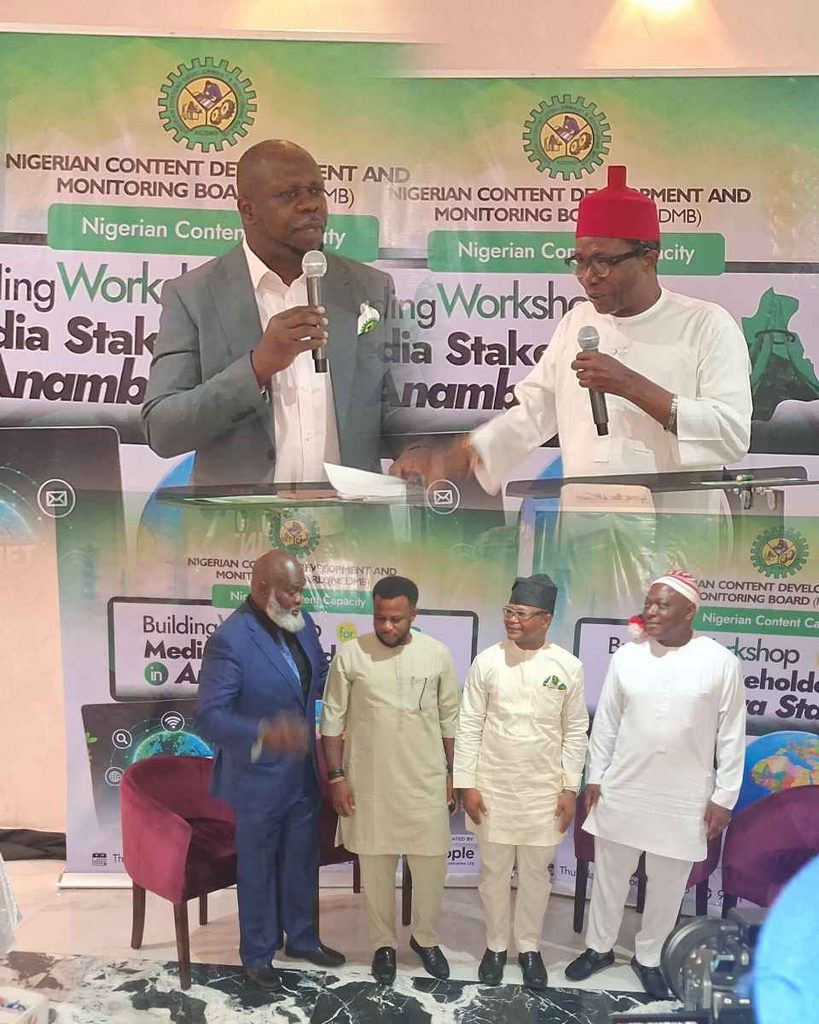
The General Manager, Corporate Communications of NCDMB, Dr. Obinna Ezeobi, made the call during the Nigerian Content Media Stakeholders Workshop for Editors and Journalists held at Golden Tulip, Awka, on Thursday.
Ezeobi described the workshop as a strategic initiative to strengthen collaboration between the Board and the media, improve industry reporting, and educate citizens and businesses on opportunities across the oil and gas value chain.
He said the Awka engagement was the first edition of the Board’s annual media stakeholders workshop to be held in the South-East since the initiative began in Port Harcourt in 2019.
Explaining the choice of Anambra, Ezeobi highlighted the state’s growing relevance to Nigeria’s oil and gas industry, noting that it has an estimated production capacity of 3,000 barrels per day and is home to prominent indigenous companies operating in the sector.
He cited industry leaders, including Engr. Emeka Okwuosa of OilServ and Dr. Ernest Nnaemeka Azudialu-Obiejesi of Nestoil Group, as examples of indigenous participation in the industry.
According to him, Nigerian Content is designed to build local capacity, strengthen indigenous enterprises, promote domestic manufacturing, and ensure that a greater proportion of the value generated by the oil and gas industry remains within Nigeria.
Ezeobi noted that the NCDMB, established in 2010 following the enactment of the Nigerian Oil and Gas Industry Content Development (NOGICD) Act, considers the media a critical partner in advancing its mandate.
He urged journalists to provide accurate, informed and investigative coverage of industry activities, explain available opportunities, and monitor compliance with local content requirements.
In his remarks, Anambra State Commissioner for Health, Hon. Dr. Law Mefor, urged the media to intensify public enlightenment efforts in support of the NCDMB, particularly by educating citizens on the Board’s mandate and its role in developing local capacity within the oil and gas industry.
Mefor expressed concern that despite Anambra’s substantial gas resources, the state had yet to benefit significantly from the opportunities associated with the sector. He observed that the state had contributed considerable resources to Nigeria’s gas development but lacked direct access to the gas needed to power its industries.
The commissioner expressed concern that Anambra was yet to be adequately captured in Nigeria’s Gas Master Plan, despite its resource potential and the opportunities gas development could create for industrialisation and economic growth.
According to statistics from the NCDMB regarding the distribution of oil production across the South-East, Imo State is the South-East region’s leading oil producer, with an estimated 17,000 barrels per day, followed by Abia State with approximately 11,000 barrels daily and Anambra with about 3,000 barrels per day.
NCDMB also noted the need for a review of the Gas Master Plan to adequately incorporate Anambra State, alongside an assessment of the economic viability of establishing a gas hub in the state.
The body stressed that the Anambra State Government should take the lead in articulating and advancing the state’s demands through sustained engagement with relevant federal institutions, ensuring that its resource contributions and development needs receive appropriate attention.
The workshop featured presentations on the NCDMB’s mandate, programmes and achievements, as well as discussions on Nigerian Content and community development. Participants also received guidance on producing impactful stories on technical sectors such as oil and gas.
Ezeobi expressed confidence that the engagement would deepen journalists’ understanding of Nigerian Content, strengthen partnerships between the Board and media organisations, and encourage greater participation by Anambra indigenes in the oil and gas industry.
He urged journalists to use their platforms to highlight available opportunities, scrutinise industry activities, and ensure that Nigerian businesses and host communities benefit from the implementation of local content policies.